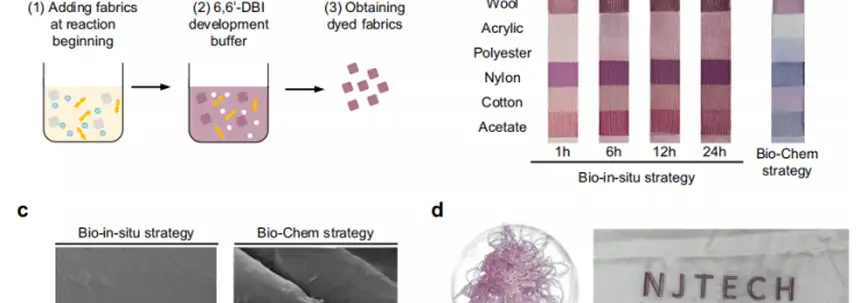
In December 2025, the team led by Zhu Chenjie and Tan Zhuo Tao from Nanjing University of Technology published a groundbreaking study in Nature Communications, introducing an integrated technology for indigo dyes using "biocatalytic synthesis + in-situ coloring".
1. Key technical points
This technology utilizes a dual-enzyme cascade system of alcohol dehydrogenase (HLADH) and flavin monooxygenase (mFMO) to achieve autocatalytic cycling without external catalysts or reducing agents. Dye synthesis and fabric coloring are performed simultaneously in a single reactor.
Key data: Dye production via shake flask fermentation reaches 367.5 mg/L, with a space-time yield of 15.31 mg/(L・h) and an atom economy of 82.5%. Water consumption during coloring is reduced by over 95%, and environmental factors drop to 1.21, completely solving the high pollution and water usage issues of traditional processes.
2. Application value
It has successfully resolved the historical challenge of dyeing synthetic fibers such as nylon and wool with "Tyler Purple". By controlling substituents, diverse colors can be customized, providing a new paradigm for green manufacturing of high-end textiles.